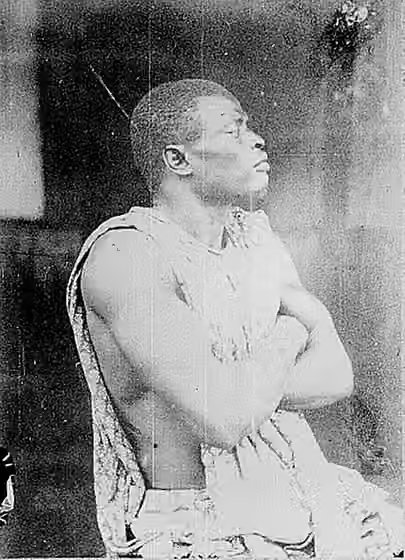
Nama dan identitas
Serer · Serer people
Adaptasi sumber terbuka. Uraian diterjemahkan otomatis menggunakan OPUS-MT en-id (lokal); teks asal dapat diperiksa di setiap bagian. Identitas, lisensi, dan kelengkapan diperiksa secara otomatis. Belum ada tinjauan komunitas atau ahli yang tercatat.
Identitas dan konteks kelompok#
Orang-orang Seer (Sererer: Seeerer atau Sereer) adalah kelompok dan bangsa yang bersifat agama Afrika Barat, "hari ini tersebar di beberapa negara kecil di pantai atau didorong kembali ke hutan pedalaman, harus menjadi salah satu tertua di Senembia."
Orang Serr berasal dari Lembah Sungai Senegal, di perbatasan Senegal dan Mauritania sekarang, dan pindah ke selatan pada abad ke 11 dan ke-12 dan bermigrasi lagi pada abad ke-15 dan ke - 16. Mereka memiliki budaya menetap kurang gerak dan telah dikenal untuk keahlian pertanian mereka dan transhumant saham-pengumpulan.
Rujukan bagian ini · revisi 1379920351Baca teks sumber bahasa Inggris
The Serer people (Serer proper: Seereer or Sereer) are a West African ethnoreligious group and nation, "today scattered in several small states on the coast or pushed back into the woods of the interior, must be one of the oldest in Senegambia."
The Serer people originated in the Senegal River Valley, at the border of present-day Senegal and Mauritania, and moved south in the 11th and 12th century and migrated again in the 15th and 16th centuries. They have had a sedentary settled culture and have been known for their farming expertise and transhumant stock-raising.
Uraian sumber 2#
Orang-orang Seer terutama ditemukan di Senegal kontemporer, terutama di bagian tengah barat negara, berjalan dari tepi selatan Dakar ke perbatasan Gambia. Seer terdiri dari berbagai bangsa yang jumlahnya paling banyak.
Serer-Noon menempati daerah kuno Thiès di Senegal modern. Serer-Ndut ditemukan di Cayor selatan dan barat laut Thiès kuno. Serer-Njeghen menempati tua Baol; Serer-Palor menempati barat-pusat, barat daya Thiès dan Serer-Laalaa menempati pusat barat, utara Thiès dan daerah Tambacounda.
Rujukan bagian ini · revisi 1379920351Baca teks sumber bahasa Inggris
The Serer people are primarily found in contemporary Senegal, particularly in the west-central part of the country, running from the southern edge of Dakar to the border of The Gambia. The Serer include the various Serer peoples of which the Seex people (pronounced Seh) are the most numerous.
The Serer-Noon occupy the ancient area of Thiès in modern-day Senegal. The Serer-Ndut are found in southern Cayor and north west of ancient Thiès. The Serer-Njeghen occupy old Baol; the Serer-Palor occupy the west central, west southwest of Thiès and the Serer-Laalaa occupy west central, north of Thiès and the Tambacounda area.
Uraian sumber 3#
Diop melanjutkan, " Hal itu akan konsisten dengan kedudukan agama mereka sekarang: mereka adalah salah satu penduduk Senegal yang langka yang masih menolak Islam. Rute mereka ditandai oleh batu tegak ditemukan pada sekitar lintang yang sama dari Ethiopia sepanjang jalan ke Sine-Salum, habitat mereka sekarang. " Profesor Molefi Kete Asante dan al. setuju cukup banyak dengan Profesor Diop, dan posits bahwa, "mereka adalah orang-orang kuno yang sejarah mencapai jauh ke masa lalu..." dan itu akan konsisten dengan mereka "hubungan kuat dengan masa lalu religius kuno mereka ".
Rujukan bagian ini · revisi 1379920351Baca teks sumber bahasa Inggris
Diop continued: "That would be consistent with their present religious position: they are one of the rare Senegalese populations who still reject Islam. Their route is marked by the upright stones found at about the same latitude from Ethiopia all the way to the Sine-Salum, their present habitat." Professor Molefi Kete Asante et al. agrees pretty much with Professor Diop, and posits that, "they are an ancient people whose history reaches deep into the past..." and that would be consistent with their "strong connection to their ancient religious past".
Perubahan dan konteks sejarah#
Profesor Dennis Galvan menulis bahwa "Rekaman sejarah lisan, catatan tertulis oleh penjelajah Arab dan Eropa awal, dan bukti antropologi fisik menunjukkan bahwa berbagai macam orang Serr bermigrasi ke selatan dari wilayah Fuuta Tooro (lembah Sannegal) mulai sekitar abad kesebelas ketika Islam pertama kali melintasi Sahara." Periode panjang ini, Wolof-Serer, telah menutupi asal-usul "terminologi, institusi, struktur politik, dan praktek." yang memberikan tanggal yang sedikit lebih lambat untuk ethogenesis mereka, menulis bahwa "Pebentukan etnis Sereer kembali ke abad ke-13, ketika sebuah kelompok datang dari Sungai Senegal di utara Islam, dan dekat Niakhar bertemu dengan kelompok Mandinka lain yang disebut Gelwar, yang berasal dari tenggara (Gravrand 1983).
Tradisi lisan mereka sendiri membaca legenda yang menghubungkan mereka sebagai "bagian dari, atau erat terkait dengan, kelompok yang sama sebagai nenek moyang Tukulor hari ini" (orang Toucueur) di daerah Sungai Senegal.
Rujukan bagian ini · revisi 1379920351Baca teks sumber bahasa Inggris
Professor Dennis Galvan writes that "The oral historical record, written accounts by early Arab and European explorers, and physical anthropological evidence suggest that the various Serer peoples migrated south from the Fuuta Tooro region (Senegal River valley) beginning around the eleventh century when Islam first came across the Sahara." Over generations these people, possibly Pulaar-speaking herders originally, migrated through Wolof areas and entered the Siin and Saluum river valleys. This lengthy period of Wolof-Serer contact has clouded the origins of shared "terminology, institutions, political structures, and practices." who gave a slightly later date for their ethnogenesis, writing that "The formation of the Sereer ethnicity goes back to the thirteenth century, when a group came from the Senegal River valley in the north fleeing Islam, and near Niakhar met another group of Mandinka origin, called the Gelwar, who came from the southeast (Gravrand 1983).
Their own oral traditions recite legends that relate their being "part of, or closely related to, the same group as the ancestors of today's Tukulor" (Toucouleur people) in the Senegal River valley area.
Sumber dan cakupan
Kontributor Wikipedia bahasa Inggris · revisi artikel 2026 · diakses 2026-10-14.
Artikel tentang kelompok dalam konteks dokumentasinya; tidak mewakili semua anggota atau semua masa. Bagian uraian dipilih, penanda format dibersihkan, dan diterjemahkan otomatis.
Kontributor Wikipedia · CC BY-SA 4.0 · Riwayat dan kredit penulis · pemilihan bagian, penyuntingan bahasa, dan pembersihan penanda format serta terjemahan otomatis merupakan perubahan dari sumber.
Q739970 — identitas dan asosiasi Wikidata · Kontributor Wikidata · CC0 · revisi 2546792095. Identitas P31 dan asosiasi negara P17; bukan batas budaya, kepemilikan, atau keyakinan semua anggota. Penjelas tambahan dan rujukan dapat diperiksa pada sumber.
Informasi rilis dan ekspor metadata · Ketentuan penggunaan ulang
Pemeriksaan otomatis identitas, lisensi, sumber revisi, dan kelengkapan; bukan tinjauan ahli. Belum ada tinjauan komunitas atau ahli yang tercatat untuk profil ini. Uraian ini belum mencakup seluruh variasi yang mungkin ada.
Baca metode penyusunan