Nama dan identitas
orang Austria · bangsa Austria · Austrian people · Austrians
Adaptasi sumber terbuka. Uraian diterjemahkan otomatis menggunakan OPUS-MT en-id (lokal); teks asal dapat diperiksa di setiap bagian. Identitas, lisensi, dan kelengkapan diperiksa secara otomatis. Belum ada tinjauan komunitas atau ahli yang tercatat.
Identitas dan konteks kelompok#
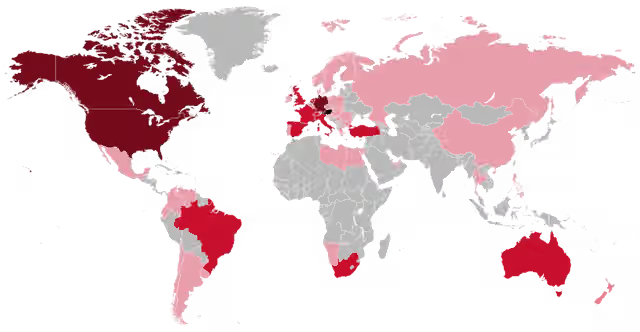
Austria (Jerman: Ogerreicher) adalah kelompok etnik dan bangsa asli Austria. Istilah Inggris Austria digunakan untuk penduduk Habsburg Austria dari abad ke - 17 atau ke - 18. Selanjutnya, selama abad ke - 19, hal itu memaksudkan penduduk Imperium Austria (1804–1867), dan dari tahun 1867 sampai 1918 kepada warga Cisleithitania. Dalam arti yang paling dekat, istilah Austria yang semula mengacu pada Maret sejarah Austria, kira-kira bertepatan dengan Basin Wina di apa yang sekarang adalah Lower Austria.
Menurut sejarah, orang Austria dianggap sebagai orang Jerman dan menganggap diri mereka seperti itu. Negeri Austria (termasuk Bohemia) adalah bagian dari Imperium Romawi Suci dan Konfederasi Jerman sampai Perang Austro-Prussia pada tahun 1866 yang mengakibatkan Prusia mengusir Imperium Austria dari Konfederasi. Jadi, ketika Jerman didirikan sebagai negara bangsa pada tahun 1871, Austria bukan bagian dari itu. Pada tahun 1867, Austria direformasi menjadi Kekaisaran Austro-Hungaria. Setelah runtuhnya Imperium Austro-Husia pada tahun 1918 pada akhir Perang Dunia I, Austria berkurang menjadi negara bagian pantat dan diadopsi dan diadopsi dan secara singkat menggunakan nama Republik Jerman-Austria (Jerman: Republik Deutschösterreich) dalam upaya untuk bersatu dengan Jerman, tetapi dilarang karena Perjanjian Saint-Germain-Laye (19). Republik Austria yang pertama didirikan pada tahun 1919. Jerman Nazi menguasai Austria bersama Anschlus pada tahun 1938.
Rujukan bagian ini · revisi 1380077465Baca teks sumber bahasa Inggris
Austrians (German: Österreicher) are an ethnic group and nation native to Austria. The English term Austrians was applied to the population of Habsburg Austria from the 17th or 18th century. Subsequently, during the 19th century, it referred to the citizens of the Empire of Austria (1804–1867), and from 1867 until 1918 to the citizens of Cisleithania. In the closest sense, the term Austria originally referred to the historical March of Austria, corresponding roughly to the Vienna Basin in what is today Lower Austria.
Historically, Austrians were regarded as Germans and viewed themselves as such. The Austrian lands (including Bohemia) were part of the Holy Roman Empire and the German Confederation until the Austro-Prussian War in 1866 which resulted in Prussia expelling the Austrian Empire from the Confederation. Thus, when Germany was founded as a nation-state in 1871, Austria was not a part of it. In 1867, Austria was reformed into the Austro-Hungarian Empire. After the collapse of the Austro-Hungarian Empire in 1918 at the end of World War I, Austria was reduced to a rump state and adopted and briefly used the name the Republic of German-Austria (German: Republik Deutschösterreich) in an attempt for union with Germany, but was forbidden due to the Treaty of Saint-Germain-en-Laye (1919). The First Austrian Republic was founded in 1919. Nazi Germany annexed Austria with the Anschluss in 1938.
Nama dan istilah#
Kata Austria dalam bahasa Inggris adalah turunan nama Austria, yang merupakan bahasa Latinisasi Ogerreich, nama Jerman untuk Austria. Kata ini berasal dari Ostarrîchi, yang pertama kali muncul pada 996. Selanjutnya, hal ini mungkin adalah terjemahan dari bahasa Latin Marcha Oriental, yang berarti " tanah perbatasan timur " (viz. yang memisahkan perbatasan timur Imperium Romawi Suci). Itu adalah margraviate dari Duchy Bavaria, diperintah oleh House of Babeenberg dari AD 976. Selama abad ke - 12, orang-orang Oriental di bawah suku Babeenbergs menjadi merdeka dari Bavaria. Apa yang sekarang dikenal sebagai Lower Austria sesuai dengan Marcha Oriental, sedangkan Austria bagian atas bertepatan dengan bagian timur wilayah utama Bavaria (setengah barat membentuk bagian negara bagian Jerman di Bavaria).
Kata sifat Austria memasuki bahasa Inggris pada awal abad ke-17, pada saat mengacu ke Habsburg Austria dalam arti "anggota cabang Austria dari Rumah Habsburg" (cabang junior yang muncul dari dinasti Austria dan Spanyol Habsburgs pada tahun 1521), tetapi dari abad ke-18 juga "a native atau penduduk Austria"
Rujukan bagian ini · revisi 1380077465Baca teks sumber bahasa Inggris
The English word Austrian is a derivative of the proper name Austria, which is a Latinization of Österreich, the German name for Austria. This word is derived from Ostarrîchi, which first appears in 996. This, in turn, is probably a translation of the Latin Marcha Orientalis, which means "eastern borderland" (viz. delimiting the eastern border of the Holy Roman Empire). It was a margraviate of the Duchy of Bavaria, ruled by the House of Babenberg from AD 976. During the 12th century, the Marcha Orientalis under the Babenbergs became independent of Bavaria. What is today known as Lower Austria corresponds to the Marcha Orientalis, while Upper Austria corresponds to the eastern half of the core territory of Bavaria (the western half forming part of the German state of Bavaria).
The adjective Austrian entered the English language in the early 17th century, at the time referring to Habsburg Austria in the sense of "members of the Austrian branch of the House of Habsburg" (the junior branch emerging from the dynastic split into Austrian and Spanish Habsburgs in 1521), but from the 18th century also "a native or inhabitant of Austria".
Perubahan dan konteks sejarah#
Setelah kekalahan Magyars pada Pertempuran Lechfeld pada tahun 955, Maret Timur atau Maret Austria menjadi bagian tertimur Imperium Romawi Suci, berbatasan dengan Moravia di utara dan di kerajaan Hongaria di timur. Sebagai akibatnya, tokoh nasional Austro-Bavarian berbicara tentang mayoritas penduduk Austria di seluruh awal sejarah modern dan modern mereka tetap dicirikan oleh lingkungan mereka di daerah Slavia Barat (Czechs, Slovakia) di utara, Slavia Selatan (Slovenes, Carinthian Slovenes, Burgenland Croats) di selatan, dan orang Hungaria di timur.
Rujukan bagian ini · revisi 1380077465Baca teks sumber bahasa Inggris
After the defeat of the Magyars at the Battle of Lechfeld in 955, the East March or March of Austria came to be the easternmost portion of the Holy Roman Empire, bordering on Moravia to the north and on the Kingdom of Hungary to the east. As a consequence, the national character of the Austro-Bavarian speaking majority population of Austria throughout their early modern and modern history remained characterized by their neighbourhood to the West Slavs (Czechs, Slovaks) to the north, the South Slavs (Slovenes, Carinthian Slovenes, Burgenland Croats) to the south, and the Hungarians to the east.
Sumber dan cakupan
Kontributor Wikipedia bahasa Inggris · revisi artikel 2026 · diakses 2026-10-14.
Artikel tentang kelompok dalam konteks dokumentasinya; tidak mewakili semua anggota atau semua masa. Bagian uraian dipilih, penanda format dibersihkan, dan diterjemahkan otomatis.
Kontributor Wikipedia · CC BY-SA 4.0 · Riwayat dan kredit penulis · pemilihan bagian, penyuntingan bahasa, dan pembersihan penanda format serta terjemahan otomatis merupakan perubahan dari sumber.
Q237534 — identitas dan asosiasi Wikidata · Kontributor Wikidata · CC0 · revisi 2547792108. Identitas P31 dan asosiasi negara P17; bukan batas budaya, kepemilikan, atau keyakinan semua anggota. Penjelas tambahan dan rujukan dapat diperiksa pada sumber.
Informasi rilis dan ekspor metadata · Ketentuan penggunaan ulang
Pemeriksaan otomatis identitas, lisensi, sumber revisi, dan kelengkapan; bukan tinjauan ahli. Belum ada tinjauan komunitas atau ahli yang tercatat untuk profil ini. Uraian ini belum mencakup seluruh variasi yang mungkin ada.
Baca metode penyusunan