Nama dan identitas
Twelve-tone technique · twelve-tone technique · twelve-tone music · dodecaphony · twelve-tone serialism · twelve-note composition · twelve-note technique · twelve-note serialism · twelve-note music · 12-tone technique · 12-tone music
Adaptasi sumber terbuka. Uraian diterjemahkan otomatis menggunakan OPUS-MT en-id (lokal); teks asal dapat diperiksa di setiap bagian. Identitas, lisensi, dan kelengkapan diperiksa secara otomatis. Belum ada tinjauan komunitas atau ahli yang tercatat.
Identitas dan konteks budaya#
Dua belas-Tone technique—also dikenal sebagai dodecaphony, 12-ton serialisme, dan (dalam penggunaan Inggris) 12 not composition—is metode komposisi musik. Teknik ini adalah sarana untuk memastikan bahwa semua 12 catatan skala kromatik terdengar sama sering dalam sepotong musik sambil mencegah penekanan satu catatan melalui penggunaan baris nada, perintah dari 12 kelas pitch. Semua 12 nada diberikan lebih atau kurang sama pentingnya, dan musik tidak berada dalam kunci.
Teknik ini pertama kali dibuat oleh komponis Austria Josef Matthias Hauer, yang menerbitkan "hukum dari dua belas nada" pada tahun 1919. Pada tahun 1923, Arnold Schoenberg (1874–1951) mengembangkan versi teknik 12-tone-nya sendiri yang lebih dikenal, yang menjadi terkait dengan komposer "Second Viennese School," yang merupakan pengguna utama teknik dalam dekade pertama keberadaannya. Seiring waktu, teknik meningkat sangat populer dan akhirnya menjadi luas berpengaruh pada pertengahan abad ke-20 komposer. Banyak komposer penting yang awalnya tidak berlangganan atau secara aktif menentang teknik itu, seperti Aaron Copland dan Igor Stravinsky, yang akhirnya mengadopsinya dalam musik mereka.
Rujukan bagian ini · revisi 1371005954Baca teks sumber bahasa Inggris
The twelve-tone technique—also known as dodecaphony, twelve-tone serialism, and (in British usage) twelve-note composition—is a method of musical composition. The technique is a means of ensuring that all 12 notes of the chromatic scale are sounded equally often in a piece of music while preventing the emphasis of any one note through the use of tone rows, orderings of the 12 pitch classes. All 12 notes are thus given more or less equal importance, and the music avoids being in a key.
The technique was first devised by Austrian composer Josef Matthias Hauer, who published his "law of the twelve tones" in 1919. In 1923, Arnold Schoenberg (1874–1951) developed his own, better-known version of 12-tone technique, which became associated with the "Second Viennese School" composers, who were the primary users of the technique in the first decades of its existence. Over time, the technique increased greatly in popularity and eventually became widely influential on mid-20th-century composers. Many important composers who had originally not subscribed to or actively opposed the technique, such as Aaron Copland and Igor Stravinsky, eventually adopted it in their music.
Perubahan dan konteks sejarah#
Teknik 12 nada paling sering dikaitkan dengan komposer Austria Arnold Schoenberg. Ia ingat menggunakannya pada tahun 1921 dan menjelaskannya kepada murid-murid dua tahun kemudian. Bersamaan dengan itu, Josef Matthias Hauer sedang merumuskan teori serupa dalam tulisannya. Dalam edisi kedua bukunya Vom Wesen Des Musikalischen (On the Essence of Music, 1923), Hauer menulis bahwa hukum melodi akson menuntut semua dua belas nada untuk dimainkan berulang kali.
Metode ini digunakan selama 20 tahun ke depan hampir eksklusif oleh komposer dari Wina Kedua School—Alban Berg, Anton Webern, dan Schoenberg sendiri. Akan tetapi, penggubah penting lainnya pada periode ini, Elisabeth Lutyens, menulis lebih dari 50 keping menggunakan metode seri.
Rujukan bagian ini · revisi 1371005954Baca teks sumber bahasa Inggris
The twelve-tone technique is most often attributed to Austrian composer Arnold Schoenberg. He recalls using it in 1921 and describing it to pupils two years later. Simultaneously, Josef Matthias Hauer was formulating a similar theory in his writings. In the second edition of his book Vom Wesen Des Musikalischen (On the Essence of Music, 1923), Hauer wrote that the law of the atonal melody requires all twelve tones to be played repeatedly.
The method was used during the next twenty years almost exclusively by the composers of the Second Viennese School—Alban Berg, Anton Webern, and Schoenberg himself. However, another important composer in this period, Elisabeth Lutyens, wrote over 50 pieces using the serial method.
Uraian sumber 3#
Transformasi khusus (prime, inversion, retrograde, retrograde-inversion) bersama-sama dengan pilihan tingkat transposisi disebut sebagai bentuk set atau bentuk baris. Jadi, setiap baris memiliki hingga 48 bentuk baris. (Beberapa baris memiliki lebih sedikit karena simetri; lihat bagian pada baris turun dan tidak sama di bawah.)
Rujukan bagian ini · revisi 1371005954Baca teks sumber bahasa Inggris
A particular transformation (prime, inversion, retrograde, retrograde-inversion) together with a choice of transpositional level is referred to as a set form or row form. Every row thus has up to 48 different row forms. (Some rows have fewer due to symmetry; see the sections on derived rows and invariance below.)
Uraian sumber 4#
P, R, saya dan RI dapat dimulai pada salah satu dari dua belas catatan skala kromatik, berarti 47 permutasi baris nada awal dapat digunakan, memberikan maksimum 48 baris nada mungkin. Akan tetapi, tidak semua seri utama akan menghasilkan begitu banyak variasi karena transformasi yang ditransposedkan mungkin identik satu sama lain. Ini dikenal sebagai ketidak-varian. Sebuah kasus sederhana adalah skala kromatik naik, inversi retrograde yang identik dengan bentuk prima, dan retrograde yang identik dengan inversi (kita, hanya 24 bentuk baris nada ini tersedia).
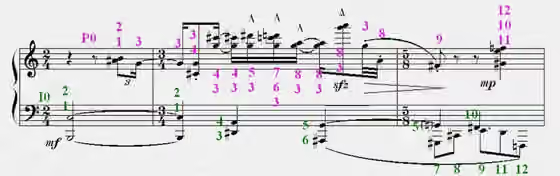
Dalam contoh di atas, seperti yang khas, inversi retrograde berisi tiga titik di mana urutan dua pitches identik dengan baris utama. Dengan demikian, kekuatan generatif bahkan yang paling dasar transformasi keduanya tidak dapat diprediksi dan tidak terelakkan. Perkembangan motivic dapat didorong oleh konsistensi internal tersebut.
Rujukan bagian ini · revisi 1371005954Baca teks sumber bahasa Inggris
P, R, I and RI can each be started on any of the twelve notes of the chromatic scale, meaning that 47 permutations of the initial tone row can be used, giving a maximum of 48 possible tone rows. However, not all prime series will yield so many variations because transposed transformations may be identical to each other. This is known as invariance. A simple case is the ascending chromatic scale, the retrograde inversion of which is identical to the prime form, and the retrograde of which is identical to the inversion (thus, only 24 forms of this tone row are available).
In the above example, as is typical, the retrograde inversion contains three points where the sequence of two pitches are identical to the prime row. Thus the generative power of even the most basic transformations is both unpredictable and inevitable. Motivic development can be driven by such internal consistency.
Sumber dan cakupan
Kontributor Wikipedia bahasa Inggris · revisi artikel 2026 · diakses 2026-10-15.
Artikel tentang entitas budaya dalam konteks dokumentasinya; tidak mewakili semua variasi, pelaku, atau semua masa. Bagian uraian dipilih, penanda format dibersihkan, dan diterjemahkan otomatis.
Kontributor Wikipedia · CC BY-SA 4.0 · Riwayat dan kredit penulis · pemilihan bagian, penyuntingan bahasa, dan pembersihan penanda format serta terjemahan otomatis merupakan perubahan dari sumber.
Q221686 — identitas dan asosiasi Wikidata · Kontributor Wikidata · CC0 · revisi 2538793421. Klasifikasi P31 dan asosiasi negara P17; bukan batas budaya, kepemilikan, atau keyakinan semua pelaku. Penjelas tambahan dan rujukan dapat diperiksa pada sumber.
Informasi rilis dan ekspor metadata · Ketentuan penggunaan ulang
Pemeriksaan otomatis identitas, lisensi, sumber revisi, dan kelengkapan; bukan tinjauan ahli. Belum ada tinjauan komunitas atau ahli yang tercatat untuk profil ini. Uraian ini belum mencakup seluruh variasi yang mungkin ada.
Baca metode penyusunan