Nama dan identitas
Feed-Drum · Nama lain belum tercatat dalam profil ini.
Adaptasi sumber terbuka. Uraian diterjemahkan otomatis menggunakan OPUS-MT en-id (lokal); teks asal dapat diperiksa di setiap bagian. Identitas, lisensi, dan kelengkapan diperiksa secara otomatis. Belum ada tinjauan komunitas atau ahli yang tercatat.
Identitas dan konteks budaya#
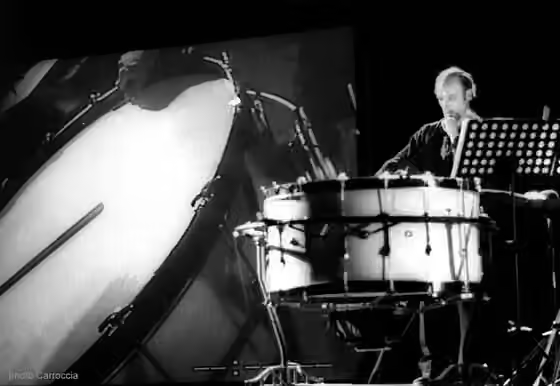
Feed-Drum adalah drum bass kekaisaran dengan sistem pengkondisian kulit elektronik yang dikandung oleh penggubah Michelangelo Lupone dan diproduksi antara CRM - Centro Ricerche Musicali, Roma dan Istituto Gramma di L'Aquila.
Melalui prinsip feed-back, sinyal yang dihasilkan oleh ekscitasi kulit kembali ke kulit dalam bentuk tekanan akustik. Hasilnya adalah suara yang tak terhingga berkelanjutan. Sistem ini mengontrol pergerakan kulit, dan karena itu tingkat pembusukan suara, dan memungkinkan isolasi mode frekuensi tinggi oleh aksi gabungan node yang ada pada kulit dan jumlah energi masukan kembali pakan. Desain pada permukaan kulit adalah peta sederhana dari mode osilasi berdasarkan fungsi Bessel. Peta itu hanya berukuran 13 diameter dan 8 lingkaran nodal, yang terakhir dibagi menjadi semisirkel (ke kiri) dan semisirkel (ke kanan) yang aneh. Lihat juga Skin-Action.
Rujukan bagian ini · revisi 1376830835Baca teks sumber bahasa Inggris
The Feed-Drum is an imperial bass drum with a system of electronic conditioning of the skin conceived by composer Michelangelo Lupone and coproduced between CRM - Centro Ricerche Musicali, Rome and Istituto Gramma in L'Aquila.
Through the principle of feed-back, the signal produced by the excitation of the skin returns to the skin in the form of acoustic pressure. The result is an infinitely sustained sound. The system controls the damping of the movement of the skin, and therefore the decay rate of the sound, and permits isolation of high frequency modes by the combined action of nodes present on the skin and the amount of feed-back input energy. The design on the skin surface is a simplified map of the oscillatory modes based on the Bessel functions. The map was limited to 13 diameters and 8 nodal circles, the latter divided into even semicircles (to the left) and odd semicircles (to the right). See also Skin-Act.
Uraian sumber 2#
Meskipun kulit drum bass kekaisaran memungkinkan ekscitasi dari sejumlah besar mode frekuensi tinggi, durasi mereka pada waktunya tidak biasanya dihargai oleh pendengar, selain dari kontribusi timbral untuk fase serangan suara. Kemungkinan variasi dari mode emisi, memadai untuk respons akustik yang cukup dari resonator (shell), terbatas dan dengan sedikit modulabilitas. Frekuensi dasar, yang diperoleh oleh ketegangan kulit, atas dan bawah, setiap terikat ke tepi dengan 16 batang dasi mekanis, dipengaruhi oleh distribusi non-homogen kekuatan ketegangan yang berkontribusi untuk membuat spektrum dari mode nyata yang kompleks.
Gendang bass tradisional jelas tidak memberikan karakteristik ini. Untuk menjelajahi kekayaan timbre fase serangan dan mengisolasi mode getaran, pembuat menciptakan sistem untuk memanipulasi kulit secara elektronik. Melalui prinsip umpan balik, sistem itu mengembalikan sinyal yang dihasilkan oleh eksitasi kulit kembali ke kulit sebagai tekanan akustik. Ini menghasilkan perpanjangan suara yang tak terbatas. Sistem ini mengontrol kelembaban kulit, dan karena itu tingkat pembusukan suara, dan mengizinkan mengisolasi mode frekuensi tinggi dengan tindakan gabungan node yang ada pada kulit dan jumlah energi masukan kembali pakan.
Rujukan bagian ini · revisi 1376830835Baca teks sumber bahasa Inggris
Although the skin of an imperial bass drum allows the excitation of a considerable number of high-frequency modes, their duration in time is not normally appreciable by the listener, apart from the timbral contribution to the attack phase of the sound. The possible variations of the mode of emission, adequate for a sufficient acoustic response of the resonator (shell), are limited and with scarce modulability. The basic frequency, obtained by the tension of the skins, upper and lower, each bound to the edges with 16 mechanical tie rods, is influenced by the non-homogeneous distribution of the tensioning forces which contributes to render complex the spectrum of the real modes.
Traditional bass drums obviously do not provide these characteristics. To explore the timbre richness of the attack phase and isolate the vibrational modes, the makers created a system to electronically manipulate the skin. Through the principle of feedback, the system returns the signal produced by the excitation of the skin back to the skin as acoustic pressure. This produces infinite prolongation of the sound. The system controls the damping the skin, and therefore the decay rate of the sound, and permits isolating high frequency modes by the combined action of the nodes present on the skin and of the amount of feed-back input energy.
Uraian sumber 3#
Perilaku daried-Drum sangat kompleks dan banyak aspek tetap harus diklarifikasi. Di bawah ini adalah unsur-unsur yang dikenal, semacam itu, dan yang masih tidak terdefinisi.
dan di mana ada fungsi Bessel dari jenis pertama dan dari urutan adalah fase sewenang-wenang tergantung pada kondisi awal (tidak ada arah tertentu, karena masalah ini berlaku untuk simetri melingkar).
Rujukan bagian ini · revisi 1376830835Baca teks sumber bahasa Inggris
The behaviour of the Feed-Drum is extremely complex and many of its aspects remain to be clarified. Below are the known elements, those conjectural, and those still undefined.
and where are Bessel functions of the first kind and of an order is an arbitrary phase dependent on the initial conditions (there cannot be any privileged directions, since the problem applies to a circular symmetry).
Uraian sumber 4#
Pengisian membran melalui pengeras suara (iroma) dan panduan gelombang sepanjang 11 cm (didesain untuk menyampaikan tekanan akustik maksimum antara pusat dan 1/3 dari radius); yaitu, cukup pendek hingga faktor bentuk yang bersangkutan. Ini terbukti cukup mudah untuk mendapatkan, selain 30 Hz frekuensi dasar, 68,9 Hz frekuensi yang berhubungan dengan mode (0,2). Tidak mungkin mendapatkan frekuensi 47,8 Hz yang sesuai dengan mode (1,1). Pada frekuensi ini, perilaku udara yang sangat gembira oleh pengeras suara kemungkinan dapat disetrika dengan gerakan piston, yang melatih tekanan hampir seragam pada membran. Sebuah eksitasi seragam kurang cocok dengan bentuk modal (1,1). Spespeaker didorong oleh sinyal listrik, dihasilkan oleh sistem feed-back yang sampel sinyal yang dikeluarkan oleh sensor piezoceramic ditempatkan di tepi dan mendeteksi defleksi membran.
Rujukan bagian ini · revisi 1376830835Baca teks sumber bahasa Inggris
Excitation of the membrane is via a loudspeaker (Ø = 45 cm.) and an 11 cm-long wave guide (designed to convey maximum acoustic pressure between the center and 1/3 of the radius); that is, fairly short as far as the form factor is concerned. It proved fairly easy to obtain, in addition to the 30 Hz basic frequency, the 68.9 Hz frequency corresponding to the mode (0,2). It was on the contrary impossible to obtain the frequency of 47.8 Hz corresponding to the mode (1,1). At these frequencies, the behavior of the air excited by the loudspeaker can presumably be schematized with a piston motion, which exercises an almost uniform pressure on the membrane. A uniform excitation is poorly compatible with the modal form (1,1). The loudspeaker was driven by an electric power signal, generated by a feed-back system that sampled the signal issued by a piezoceramic sensor placed on the rim and detecting deflection of the membrane.
Sumber dan cakupan
Kontributor Wikipedia bahasa Inggris · revisi artikel 2026 · diakses 2026-10-15.
Artikel tentang entitas budaya dalam konteks dokumentasinya; tidak mewakili semua variasi, pelaku, atau semua masa. Bagian uraian dipilih, penanda format dibersihkan, dan diterjemahkan otomatis.
Kontributor Wikipedia · CC BY-SA 4.0 · Riwayat dan kredit penulis · pemilihan bagian, penyuntingan bahasa, dan pembersihan penanda format serta terjemahan otomatis merupakan perubahan dari sumber.
Q5441166 — identitas dan asosiasi Wikidata · Kontributor Wikidata · CC0 · revisi 2474521363. Klasifikasi P31 dan asosiasi negara P17; bukan batas budaya, kepemilikan, atau keyakinan semua pelaku. Penjelas tambahan dan rujukan dapat diperiksa pada sumber.
Informasi rilis dan ekspor metadata · Ketentuan penggunaan ulang
Pemeriksaan otomatis identitas, lisensi, sumber revisi, dan kelengkapan; bukan tinjauan ahli. Belum ada tinjauan komunitas atau ahli yang tercatat untuk profil ini. Uraian ini belum mencakup seluruh variasi yang mungkin ada.
Baca metode penyusunan